
Organon & Philosophy
Case taking in homeopathy: Organon aphorisms 83 to 104, explained
By Dr. Harish Kumar · October 31, 2026 · 11 min read
How Hahnemann tells the physician to take a case, step by step, from §83 to §104 of the Organon: listen, write, question, observe and assemble the picture. With a checklist and exam notes.
Every homeopathic prescription stands or falls on the case. Hahnemann knew this, and in aphorisms 83 to 104 of the Organon of Medicine he gives the most practical instructions in the whole book: how to listen, what to write down, which questions to ask and which never to ask, and how to tell when the picture is complete.
This guide walks through §83–104 in the order you would use them in a real consultation. Each section quotes the key line from Boericke's translation of the 6th edition (1922, in the public domain), explains what it means at the bedside, and links to the full aphorism in our Organon of Medicine. It ends with a one-page checklist and the questions examiners ask.
What §83 asks of the physician
"This individualizing examination of a case of disease … demands of the physician nothing but freedom from prejudice and sound senses, attention in observing and fidelity in tracing the picture of the disease."
Notice the word individualizing. Hahnemann is not describing how to confirm a diagnosis; he is describing how to record what is particular to this patient. The four qualities he asks for are attitudes, not techniques:
- Freedom from prejudice: no remedy or diagnosis in mind before the patient has finished.
- Sound senses: you observe as well as listen.
- Attention in observing: nothing is too small to note.
- Fidelity in tracing the picture: you record what is there, not what you expected.
He also says these are "general directions", of which the practitioner uses "only what is applicable for each individual case". The aphorisms that follow are a method, not a script.
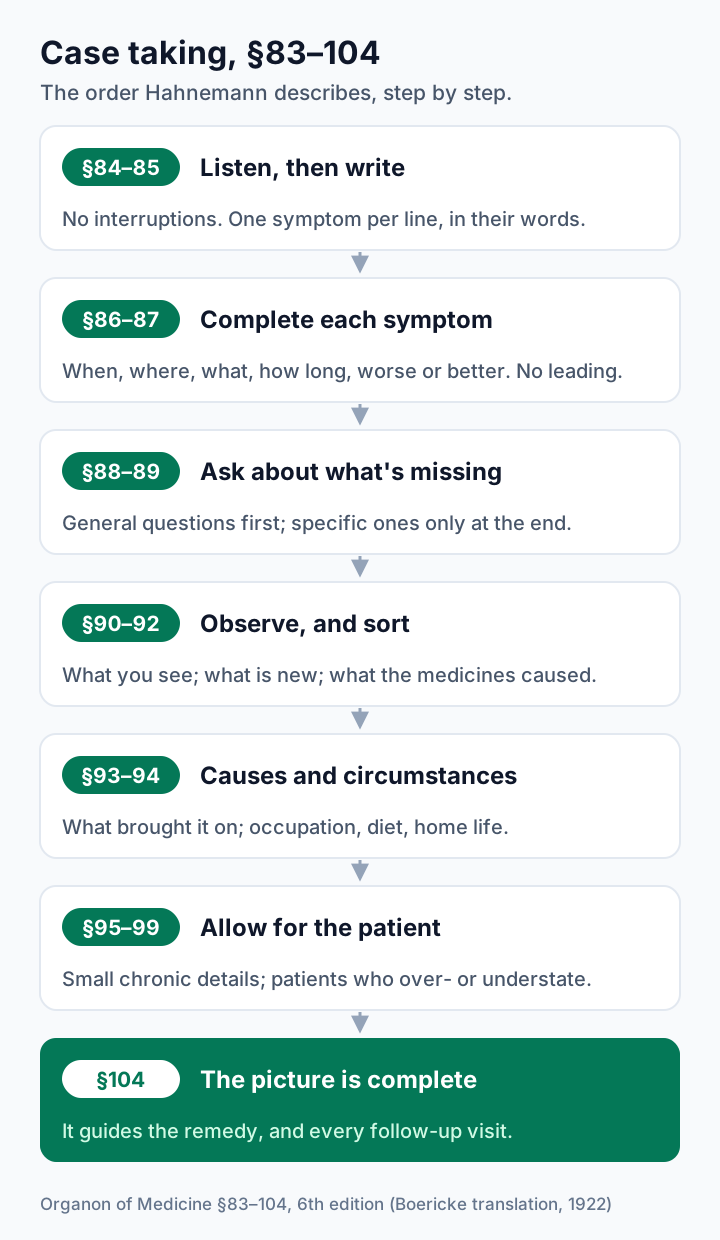
Step 1: Let the patient speak, and write it down (§84–85)
§84: listen in silence
"Keeping silence himself, he allows them to say all they have to say, and refrains from interrupting them unless they wander off to other matters."
§84 names three sources of information: the patient, who "details the history of his sufferings"; those around the patient, who tell what they heard and noticed; and the physician, who "sees, hears, and remarks by his other senses" what is altered. This is the same trio as §6, now turned into a working method.
Two instructions in §84 are easy to skip and important:
- Write down what is said "in the very expressions used by them". The patient's own words are evidence; your medical paraphrase is not.
- Do not interrupt, unless the patient wanders off the subject.
§85: one symptom per line
§85 asks the physician to begin "a fresh line with every new circumstance", so that the symptoms are "ranged separately one below the other". The reason is practical: when a vague symptom is explained more clearly later, you can add to it in the right place.
At the bedside: leave space under each line. Most of your case will be built in those spaces during Step 2.
Step 2: Complete each symptom (§86–87)
§86: the questions to ask about every symptom
When the patient has finished speaking, §86 tells the physician to go back over each symptom "one by one" and ask for the particulars. The aphorism lists the questions itself:
| Ask about | §86 asks, in effect |
|---|---|
| Timing | At what period did this symptom occur? Before, during or after the medicine already taken? |
| Sensation | What kind of pain, what sensation exactly? |
| Location | Where was the precise spot? |
| Pattern | Did it come in fits, at various times, or was it continuous? |
| Duration | How long did it last? |
| Modalities | At what time of day or night, and in what position, was it worst, or did it cease? |
These are what later teachers formalised as location, sensation, modalities and concomitants. Our post on modalities shows how to draw them out without leading the patient.
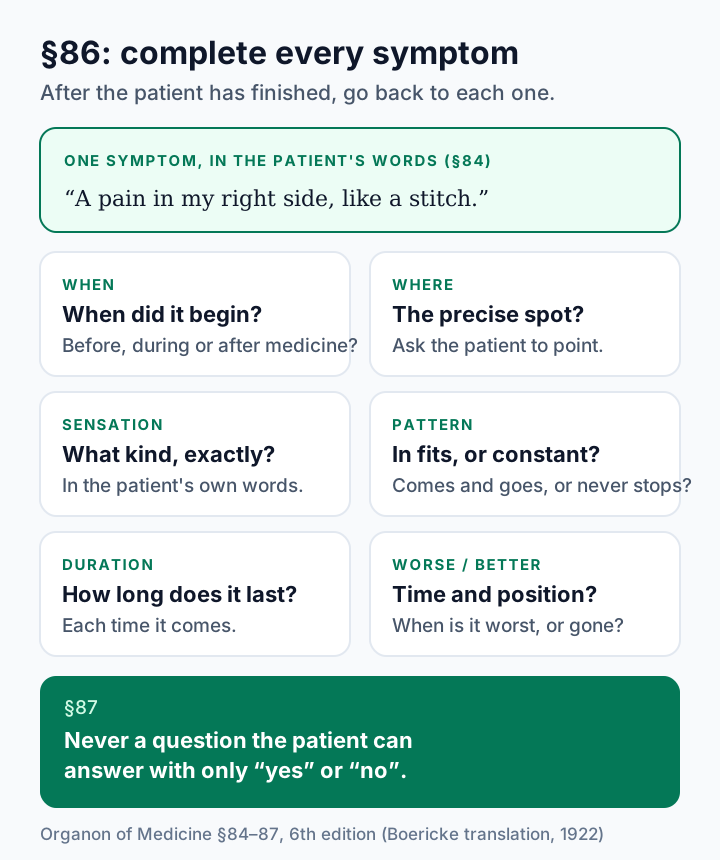
§87: never suggest the answer
"… but without ever framing his questions so as to suggest the answer to the patient, so that he shall only have to answer yes or no …"
§87 explains why: a patient asked a leading question may answer "something untrue, half true, or not strictly correct, either from indolence or in order to please his interrogator", and "a false picture of the disease" follows.
Compare:
- Leading: "Is the pain worse at night?"
- Open: "Is there any time of day or night when the pain changes?"
The open question takes longer. It is also the only one whose answer you can trust.
Step 3: Ask about what was not mentioned (§88–89)
§88: general questions about the rest of the body and the mind
If the patient's account says nothing about some parts or functions of the body, or about their state of mind, §88 tells the physician to ask, but "only … general expressions", so that the patient has to supply the details. "How is your sleep?" rather than "Do you wake at 3 a.m.?"
§89: then, and only then, specific questions
Once the patient has "traced a tolerably perfect picture of the disease", §89 allows "more precise, more special questions" if the physician still needs them. The order matters: open questions first, specific questions last. Reversing it fills the case with your expectations.
Step 4: Observe, and separate the disease from what came before (§90–92)
- §90: Note what you yourself observe in the patient, and ask how much of it was already present in their healthy state. A loud voice or a pale complexion only matters if it is new.
- §91: Symptoms that appeared while the patient was taking medicines "do not furnish the pure picture of the disease". Those from before the medicines, or after they were stopped, show "the original form of the disease". In a chronic case Hahnemann even suggests waiting some days without medicine before the detailed examination.
- §92: In an acute, serious illness there is no time to wait. The physician then takes the picture as it is, including the effects of the medicines already given, and treats that.
At the bedside: always ask which medicines the patient is taking and when each symptom started relative to them. It is the first step of §91 and it takes one minute.
Step 5: Look for causes and circumstances (§93–94)
- §93: If an obvious cause brought the disease on, the patient or the family will mention it, "either spontaneously or when carefully interrogated". The family can be "questioned privately", and Hahnemann's footnote adds that causes the patient would rather not confess must be drawn out by skilful questions or private inquiry.
- §94: In chronic disease, examine the patient's occupation, "usual mode of living and diet", "domestic situation, and so forth", to find what may "produce or … maintain disease", so that it can be removed.
This is the practical side of §5's accessory circumstances. For why it matters so much in follow-ups, read Organon §5: the fundamental cause.
Step 6: Allow for the patient in front of you (§95–99)
§95: chronic cases need the smallest details
Patients with a long illness grow used to it. They stop mentioning the "lesser accessory symptoms" and regard them "almost as health". Yet these are often "very pregnant with meaning (characteristic)" and decide the remedy. In a chronic case, ask about the small things the patient no longer notices. They are often the strange, rare and peculiar symptoms that §153 tells us to look for.
§96–97: some patients exaggerate, others hide
- §96: Some, especially the very sensitive, describe their symptoms "in too vivid colors" so that the physician will help them.
- §97: Others, from "indolence", "false modesty" or a mild disposition, leave symptoms out or call them unimportant.
Neither is lying. Both need you to weigh what you hear against what you observe.
§98: trust the patient's own words, and be patient
"… the investigation of the true, complete picture and its peculiarities demands especial circumspection, tact, knowledge of human nature, caution in conducting the inquiry and patience in an eminent degree."
§98 also says to credit the patient's own expressions over the family's retelling, because in the mouths of others they are "usually altered and erroneously stated".
§99: acute cases are easier
In acute illness everything is recent, "still fresh in the memory", and mostly told without being asked. You still need to know everything; there is simply less to dig for.
Epidemic and chronic miasmatic disease (§100–103)
§100–102 extend case taking from one patient to many:
- §100: Treat every prevailing epidemic as if it were new. Whether something like it has appeared before, under any name, makes no difference to the examination.
- §101: The first one or two patients may not show the complete picture, though a careful physician can often come close.
- §102: As more cases are written down, the picture becomes "more significant (more characteristic)", and the symptoms common to the whole epidemic emerge. The remedy chosen from this collective picture is what later teachers call the genus epidemicus, a term that does not appear in the Organon itself.
- §103: The same applies to the chronic miasms, especially psora: each patient shows only part of the whole, so their full picture can be assembled only from very many patients.
The picture is complete (§104)
"When the totality of the symptoms that specially mark and distinguish the case of disease … is once accurately sketched, the most difficult part of the task is accomplished."
With the picture written down, the physician can pick out the characteristic symptoms and find the most similar medicine. §104 also gives the method for every follow-up: at the next visit, strike out of the original list the symptoms that have improved, mark those that remain, and add any new ones. A well-kept first case record is what makes the second prescription possible.
Your case-taking checklist (§83–104)
Use this during practice cases and before your viva:
- I listened without interrupting and wrote in the patient's own words (§84).
- Each symptom is on its own line, with space below it (§85).
- For each symptom I know when, where, what sensation, the pattern, the duration and what makes it worse or better (§86).
- None of my questions could be answered with a plain yes or no (§87).
- I asked in general terms about every part and function not yet mentioned, and about the mind (§88), before any specific questions (§89).
- I noted my own observations and checked which were new (§90).
- I know which medicines the patient has taken and which symptoms came before them (§91–92).
- I asked about the cause, and about occupation, diet, habits and home (§93–94).
- In a chronic case I asked about the small, long-accepted symptoms (§95).
- I allowed for a patient who exaggerates or understates (§96–97).
For a printable case-recording format, see our homeopathic case-taking proforma.
Questions examiners ask on §83–104
- Which aphorisms deal with case taking? §83 to §104.
- What four qualities does §83 require of the physician? Freedom from prejudice, sound senses, attention in observing, and fidelity in tracing the picture of the disease.
- Why should the physician keep silent and record the patient's own words (§84)? So that the account is not shaped by the physician, and the patient's exact expressions are preserved.
- What is wrong with a question that can be answered "yes" or "no" (§87)? It suggests the answer, and the patient may agree from indolence or to please, giving a false picture.
- How should the physician treat symptoms that appeared during previous medication (§91–92)? They are not the pure picture. In chronic cases, prefer the symptoms from before or after the medicines; in serious acute cases, treat the picture as it is.
- Why does chronic case taking need special care (§95)? Patients grow used to small symptoms and stop reporting them, though these are often the most characteristic.
- How is the picture of an epidemic obtained (§100–102)? From several patients, since one patient shows only part of it.
- How does §104 guide the follow-up? Strike out the symptoms that improved, mark those that remain, and add new ones.
FAQ
Which edition of the Organon are these aphorisms from?
The 6th edition, in William Boericke's English translation (1922), which is in the public domain. If your course uses the 5th edition or a particular commentary, compare the wording with your recommended text.
Is case taking in homeopathy different from history taking in medicine?
It covers the same ground and more. A medical history aims at a diagnosis; homeopathic case taking, as §83 says, is "individualizing": it records what is particular to this patient, including sensations, modalities, the state of mind and the circumstances, because those are what distinguish one remedy from another.
Why does Hahnemann insist on the patient's own words?
Because the patient's expressions carry information a paraphrase loses. "A pain like a splinter" and "a pain like a burn" are different symptoms. §84 asks for "the very expressions used by them", and §98 warns that friends and attendants usually alter them.
Where can I practise this?
Each of our case studies opens as a practice case with a simulated patient (a free account is needed). You take the case yourself, repertorise and prescribe, and the score shows how complete your case taking was.
Keep going
This guide follows Organon aphorisms 1 to 10, explained. Read every aphorism in full in the Organon of Medicine, starting with §83, and if your first real case felt overwhelming, why you froze at your first case is written for you.
Dr. Harish Kumar
Homeopath and founder of HomeopathyWorld. Writes on materia medica, case-taking, repertory and the Organon for students and practitioners.
Put this into practice
Repertorise these symptoms against the real Kent & Bönninghausen, read the full Materia Medica, and practise the case on an AI patient — free account, no card required.
Create your free accountMore in Organon & Philosophy
Discussion
Sign in to join the discussion.
No comments yet — start the conversation.