
Organon & Philosophy
Organon of Medicine aphorisms 1 to 10, explained
By Dr. Harish Kumar · October 26, 2026 · 11 min read
What Hahnemann says in the first ten aphorisms of the Organon, what each one means in practice, and how examiners ask about them. With a quick-review table for revision.
The first ten aphorisms of Hahnemann's Organon of Medicine are short, and students tend to rush them on the way to the "real" material. That is a mistake. Aphorisms 1 to 10 set out everything the rest of the book depends on: what a physician is for, what the physician has to know, what a disease is, what keeps a living body alive, and the standard Hahnemann calls the highest ideal of cure.
This guide takes them in five groups, quotes the key line of each from the 6th edition (Boericke's translation, which is in the public domain), explains what it means in practice, and ends with the questions examiners ask. Every aphorism links to its full text in our Organon of Medicine.
Organon aphorisms 1 to 10 at a glance
Use this table for last-minute revision. The sections below explain each line.
| § | Theme | One-line answer |
|---|---|---|
| 1 | The physician's mission | The physician's high and only mission is to restore the sick to health. |
| 2 | The highest ideal of cure | Rapid, gentle and permanent restoration of health, on easily comprehensible principles. |
| 3 | What the physician must know | Knowledge of disease, of medicinal powers, of how to apply one to the other, and of obstacles to recovery. |
| 4 | Preserver of health | Knowing what deranges health, and removing it from healthy people. |
| 5 | Accessory circumstances | Exciting cause, fundamental cause (chronic miasm), constitution, character, occupation, habits, relations, age, sexual function. |
| 6 | The unprejudiced observer | Disease is known only through changes in health that can be perceived. |
| 7 | Totality of symptoms | The totality of symptoms is the principal, indeed the only, guide to the remedy. |
| 8 | Removal of all symptoms | When all symptoms are removed, nothing but health remains. |
| 9 | The vital force in health | The spiritual vital force (dynamis) keeps the organism in harmonious operation. |
| 10 | The body without vital force | Without the vital force the material organism has no sensation, no function and no self-preservation. |
§1–2: the physician's mission and the ideal of cure
Aphorism 1: the only mission
"The physician's high and only mission is to restore the sick to health, to cure, as it is termed."
The key word is only. Hahnemann's footnote to §1 spells out what the mission is not:
"His mission is not, however, to construct so-called systems, by interweaving empty speculations and hypotheses concerning the internal essential nature of the vital processes and the mode in which diseases originate in the invisible interior of the organism…"
He is not against knowledge; he is against speculation that never reaches the patient.
In practice: every later instruction in the Organon, from case taking to the dose, is judged against one question: does it help restore this patient to health?
Aphorism 2: the highest ideal of cure
"The highest ideal of cure is rapid, gentle and permanent restoration of the health, or removal and annihilation of the disease in its whole extent, in the shortest, most reliable, and most harmless way, on easily comprehensible principles."
Students are often asked to list the features of the ideal cure. Break the sentence into its parts:
- Rapid: restoration as quickly as possible.
- Gentle: without causing the patient further suffering.
- Permanent: the patient stays well; the disease does not return.
- In its whole extent: the whole disease is removed, not one symptom of it.
- Shortest, most reliable, most harmless way: the route to cure matters, not only the destination.
- Easily comprehensible principles: the method can be explained and taught, not just practised by instinct.
Exam tip: "Which aphorism describes the highest ideal of cure?" is a typical one-mark question. The answer is §2.
§3–4: what the physician must know
Aphorism 3: the four kinds of knowledge
§3 is one long sentence, and it is the closest the Organon comes to a job description. It says the physician must clearly perceive:
- What is to be cured in disease: knowledge of disease, in every individual case (the indication).
- What is curative in medicines: knowledge of medicinal powers, in each individual medicine.
- How to adapt the one to the other: the choice of the indicated remedy, its preparation, the proper dose and the right time to repeat it.
- The obstacles to recovery: and how to remove them, so that the recovery is permanent.
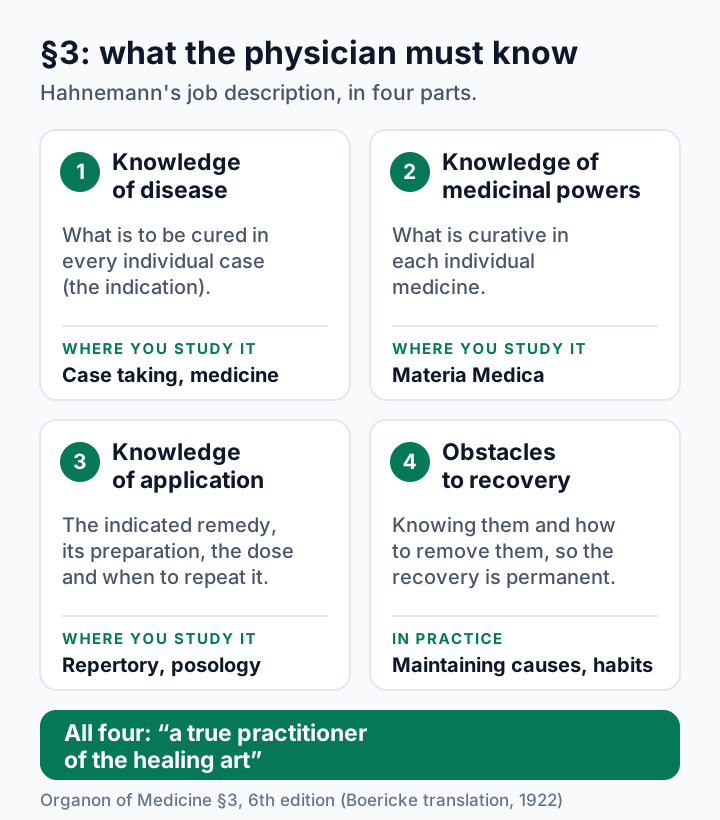
A physician who has all four, Hahnemann says, treats "judiciously and rationally" and is "a true practitioner of the healing art".
In practice: these four map directly onto your BHMS subjects. Knowledge of disease is case taking and clinical medicine; knowledge of medicines is Materia Medica; adapting one to the other is repertory and posology; obstacles to recovery are the maintaining causes, diet and lifestyle covered later in the Organon.
Aphorism 4: the preserver of health
"He is likewise a preserver of health if he knows the things that derange health and cause disease, and how to remove them from persons in health."
§4 adds prevention to the physician's role. Knowing what makes people ill is part of the job even when no one is ill yet.
§5: the accessory circumstances
§5 tells the physician what else to collect besides the symptoms:
- In acute disease: the most probable exciting cause.
- In chronic disease: the most significant points of the whole history, to find the fundamental cause, which Hahnemann says is generally a chronic miasm.
- In both, and especially in chronic cases: the patient's physical constitution, moral and intellectual character, occupation, mode of living and habits, social and domestic relations, age and sexual function.
These are the "accessory circumstances" that later aphorisms refer back to as "§5" (§7 does so directly). When a question asks for them, list them all, not only the exciting and fundamental causes.
For a longer discussion of why the exciting and maintaining causes matter in a real consultation, read Organon §5: the fundamental cause.
§6–8: what a disease is, for a homeopath
Aphorism 6: the unprejudiced observer
§6 describes the attitude the physician must bring to a case. The "unprejudiced observer" sets aside speculation that experience cannot confirm, and takes note only of the changes in the health of body and mind that can be perceived:
- felt by the patient (what the patient reports),
- remarked by those around the patient (what family and attendants notice), and
- observed by the physician (what you see and examine).
Together, these "form the true and only conceivable portrait of the disease".
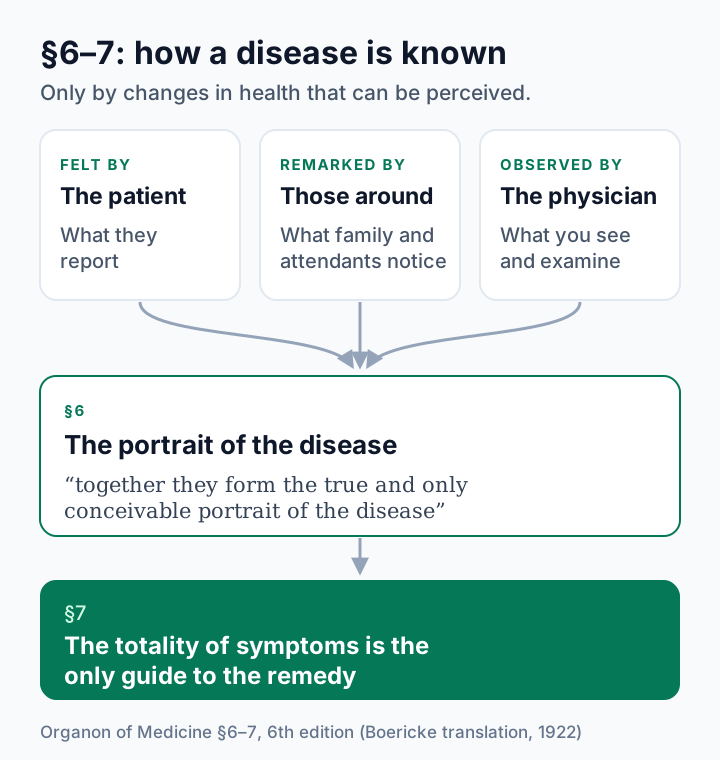
This is why case taking in homeopathy gives so much weight to the patient's own account and to the observations of relatives.
Aphorism 7: the totality of symptoms
§7 draws the conclusion. Where there is no obvious exciting or maintaining cause to remove, the symptoms are all we can perceive, so the totality of symptoms must be "the principal, or the sole means" by which the disease shows which remedy it needs. Hahnemann calls the totality the "outwardly reflected picture of the internal essence of the disease", that is, of the affection of the vital force.
Two details are easy to miss and often examined:
- The totality is qualified: Hahnemann reminds the physician to keep in mind the possibility of a miasm and the accessory circumstances of §5.
- The totality is not a symptom count. It is the whole picture of the patient's illness. Our post on the totality of symptoms covers how it is used in practice.
Aphorism 8: nothing but health remains
"It is not conceivable, nor can it be proved by any experience in the world, that, after removal of all the symptoms of the disease and of the entire collection of the perceptible phenomena, there should or could remain anything else besides health…"
§8 completes the argument of §6–7: if the disease is known only through its symptoms, then removing all of them leaves health. In Hahnemann's terms, no hidden "interior" disease can remain once its whole outward picture is gone.
§9–10: the vital force
§7 has already named "the affection of the vital force". §9 and §10 now say what the vital force is, opening a section that Hahnemann develops up to §18.
Aphorism 9: the vital force in health
"In the healthy condition of man, the spiritual vital force (autocracy), the dynamis that animates the material body (organism), rules with unbounded sway, and retains all the parts of the organism in admirable, harmonious, vital operation…"
Hahnemann describes the vital force as spiritual, autocratic (self-governing) and dynamic (the dynamis). In health it keeps sensations and functions in harmony, so that the mind "can freely employ this living, healthy instrument for the higher purposes of our existence".
Aphorism 10: the organism without the vital force
"The material organism, without the vital force, is capable of no sensation, no function, no self-preservation…"
§10 is the converse of §9. Matter alone does not live; all sensation and every function of life come from the vital principle, "in health and in disease". This prepares the ground for §11, where Hahnemann states that in illness it is primarily the vital force that is deranged.
How aphorisms 1 to 10 fit together
Read as a sequence, the first ten aphorisms make a single argument:
- The physician exists to cure (§1), and a cure has a defined standard (§2).
- To meet it, the physician needs four kinds of knowledge (§3) and should prevent disease where possible (§4).
- The case includes the circumstances around the symptoms (§5).
- Disease can be known only by its perceptible signs (§6), so their totality is the guide to the remedy (§7), and removing them all leaves health (§8).
- Behind those signs lies the vital force that keeps the healthy organism alive and in order (§9–10).
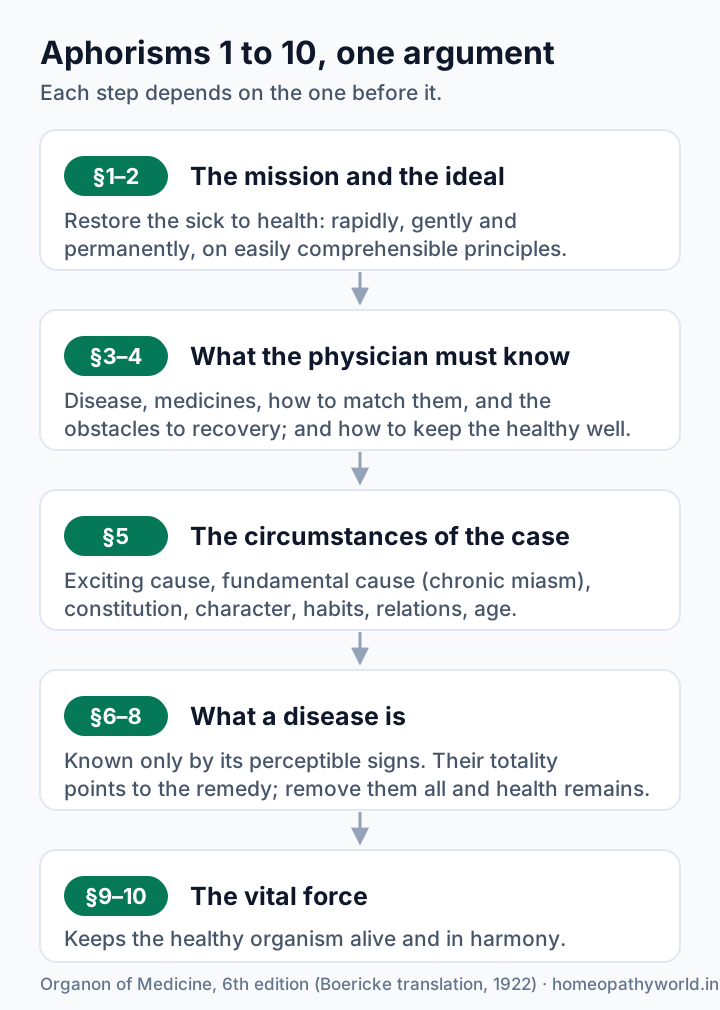
If you can reproduce that chain in your own words, you can answer almost any long question on this part of the syllabus.
Questions examiners ask on aphorisms 1 to 10
- Which aphorism states the physician's mission? §1.
- Which aphorism describes the highest ideal of cure? §2. Be ready to list its features.
- What knowledge does §3 require of the physician? Knowledge of disease, of medicinal powers, of their application (remedy, preparation, dose, repetition) and of obstacles to recovery.
- What are the accessory circumstances of §5? Exciting cause, fundamental cause (chronic miasm), physical constitution, moral and intellectual character, occupation, mode of living and habits, social and domestic relations, age and sexual function.
- Who is the "unprejudiced observer", and from whom does the physician learn the symptoms? §6: the patient, those around the patient, and the physician's own observation.
- What does §7 say is the only guide to the remedy? The totality of symptoms.
- Which aphorisms describe the vital force in health and without it? §9 and §10.
FAQ
Which edition of the Organon should BHMS students use?
The 6th edition is the standard text, and many courses also compare it with the 5th. The quotations here are from William Boericke's English translation of the 6th edition (1922), which is in the public domain. Your college may prefer a particular commentary, so check your syllabus for the recommended text.
Is aphorism 2 the same as "the ideal cure"?
Yes. §2 is usually called "the highest ideal of cure". Examiners expect the features listed above, not only the phrase "rapid, gentle and permanent".
What is the difference between §6 and §7?
§6 says how disease is known: only through perceptible changes in health. §7 draws the consequence: since that is all we can perceive, the totality of those symptoms must guide the choice of remedy.
Where does the Organon explain the vital force?
§7 already speaks of "the affection of the vital force", but §9 and §10 are where Hahnemann says what it is: in health it keeps the organism in harmonious operation, and without it the body has no sensation or function. He develops the idea up to §18; §11 adds that in illness it is the vital force that is primarily deranged.
Keep going
Read each aphorism in full, with the ones around it, in the Organon of Medicine. Next in the series is aphorism 11, where Hahnemann explains what happens to the vital force in illness.
To see what §6 and §7 mean in a consultation, try a practice case. Each of our case studies opens as a case you can take with a simulated patient (a free account is needed): you ask the questions, collect what the patient feels and what you observe, and build the totality yourself.
Dr. Harish Kumar
Homeopath and founder of HomeopathyWorld. Writes on materia medica, case-taking, repertory and the Organon for students and practitioners.
Put this into practice
Repertorise these symptoms against the real Kent & Bönninghausen, read the full Materia Medica, and practise the case on an AI patient — free account, no card required.
Create your free accountMore in Organon & Philosophy
Discussion
Sign in to join the discussion.
No comments yet — start the conversation.