
What’s new
What's new in September 2026: the Materia Medica library
By Dr. Harish Kumar · September 14, 2026 · 7 min read
The six classic Materia Medica books are now read whole, searched word by word and cited to the page, and joined up with the repertory and your case debriefs. Here is everything that changed.
The Materia Medica update went live on 14 September 2026. It rebuilds the library you read remedies in, from the texts themselves up to the page you read them on. Here is why we did it, what you will notice, and what is still being worked on.
Why we rebuilt it
A library is only useful if its text is complete and you can find what is in it. An audit in September showed that neither could be relied on:
- The same remedy was split across several records, so a search could find one half of a remedy and miss the other.
- Text was missing or misfiled. The remedy page hid Boericke's General section whenever it began like the remedy's description, which cut the text of 147 remedies short. Sixteen of Kent's lectures were filed under a neighbouring remedy. Farrington's book had been imported as 40 fused rows and had to be taken offline.
- You could not search the words of the books. The only text search was the AI search, and it returned twelve passages for any query at all, even nonsense.
All three are fixed. The rest of this post walks through the library as it is now.
Search the books
Words search
The library has a new Search the text panel with two modes. Words looks for the words themselves, in every book at once.
- Every word you type must appear in the passage. Put a minus sign before a word to leave it out, as in
thirst -cold. - Typos are corrected, and the search tells you so. Type "thrist small quantities" and it searches for thirst.
- Each result is one remedy in one book, with the section, the number of hits and your words highlighted.
Practitioner Pro adds exact phrases in quotes, burning NEAR/5 thirst for words that sit close together, and a search limited to one section.
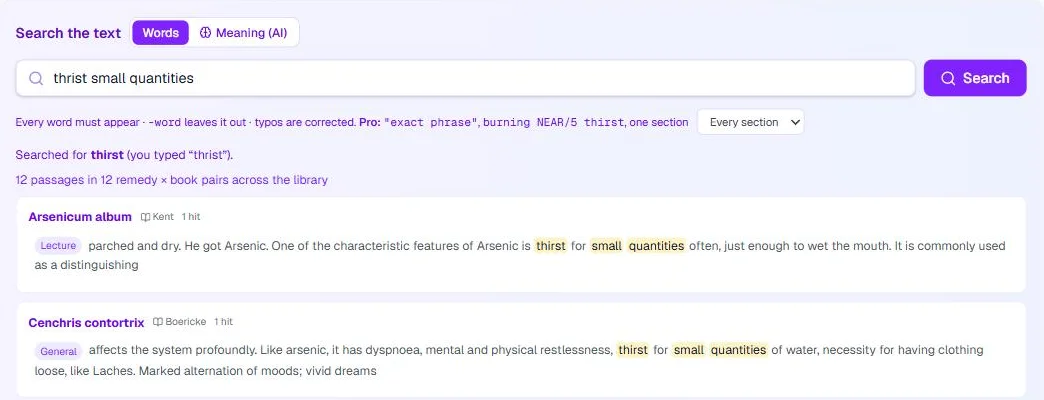
Screenshot from our own account, 14 September 2026: the typo corrected, and the first two of twelve passages.
Meaning search
Meaning (AI) is for when you remember a symptom but not how the books phrase it. Describe it in plain words and it finds passages that read alike. It now tells you when nothing is close enough ("No passage matches that closely enough") instead of always showing twelve results. It has its own daily allowance, 60 searches on the free plan and 300 on Practitioner Pro, separate from the Study Assistant.
From the books to the repertory
Under the Words results, Find repertory rubrics for these words lists the repertory rubrics that contain every word you searched, each with its repertory and its number of remedies. Tick the ones that fit your patient and press Add to the repertory basket. The repertory opens with them in Selected Rubrics and a note saying where they came from.
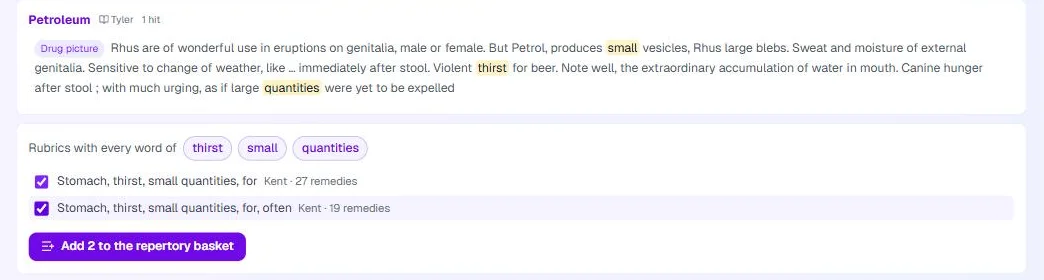
The rubrics found for "thirst small quantities", 14 September 2026.
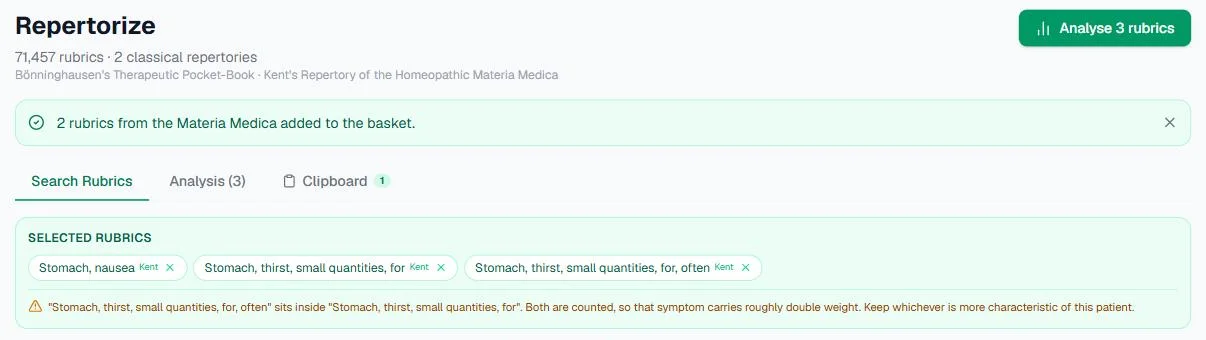
The repertory straight after. Our basket already held "Stomach, nausea". The amber note is the repertory's own warning: one of the two new rubrics sits inside the other, so that symptom would count twice, and it asks you to keep one.
Read a remedy
One page, every book
A remedy page now opens with its name, its Latin and common names, its kingdom and family, and a line of facts cited to the page they come from, such as "Facts: Allen, Keynotes (1910), p. 259". A short lead follows, with Read on to jump to the passage it comes from. Below it, one chip per book lets you read every book or just one.
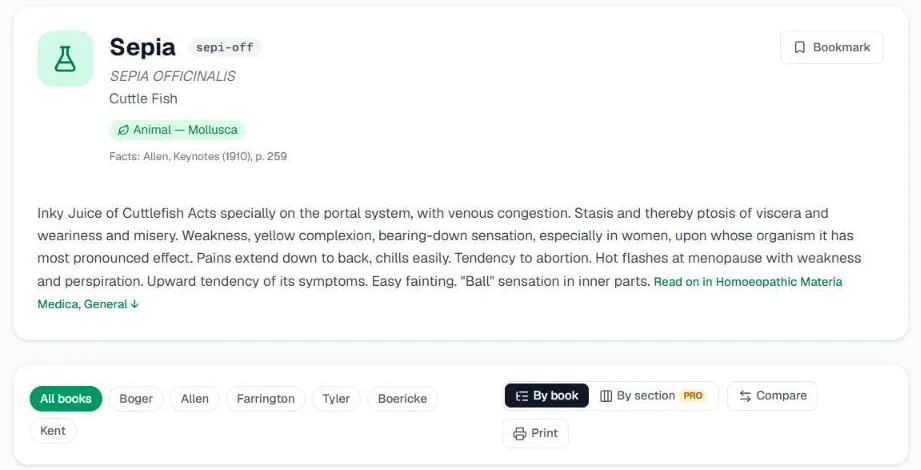
The top of the Sepia page, 14 September 2026.
Every book's text is shown whole. The General section that used to disappear is back, and the lead no longer stands in for it.
Contents
Contents lists every book on the page with links to its sections. Kent and Farrington wrote lectures rather than sections, so each lecture is one link, and Kent's shows the topics it covers. Each book's heading gives its author, when its text was last updated, and notes that help you read it, such as "Words in capitals are Boger's highest grade".
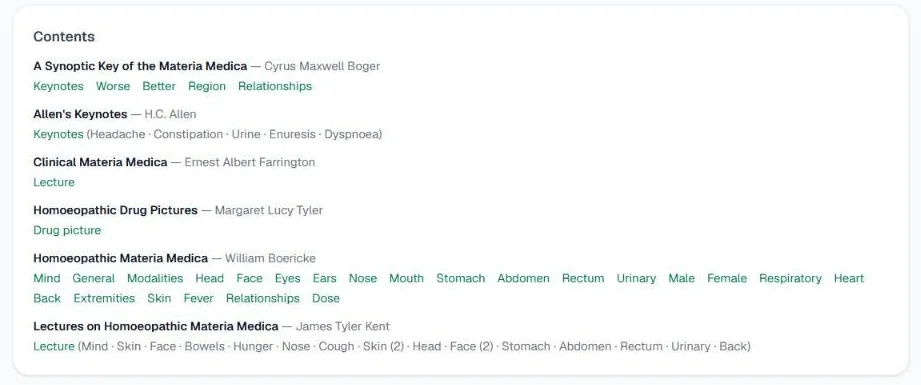
Contents on the Sepia page, 14 September 2026.
Cite and save a passage
Every passage has Cite and Save. Cite opens a ready-made reference, with the author, book, year, section and a link back to the passage, and a Copy button. The text is selectable too, in case your browser blocks copying. Save adds the passage to your Bookmarks page.
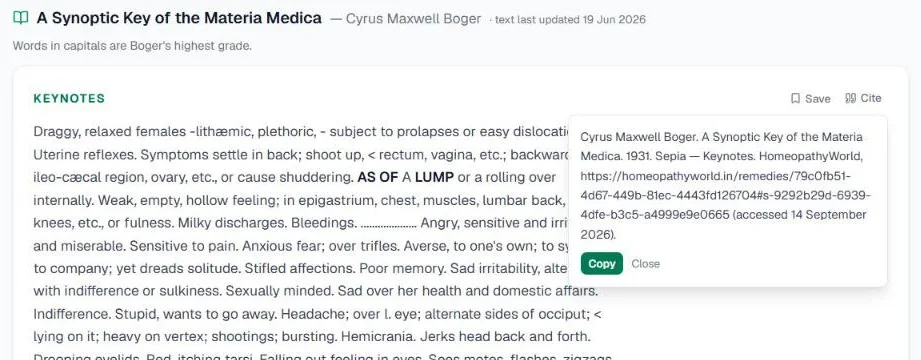
A citation on the Sepia page, 14 September 2026.
Relationships
Relationships gathers complementary remedies, remedies that follow well, antidotes, inimicals, compatible and related remedies: 1,828 in all, from Boericke's and Boger's Relationships sections and Allen's Keynotes. Each name carries the book it comes from. Remedies an author only compares are left in the text rather than counted as relationships.
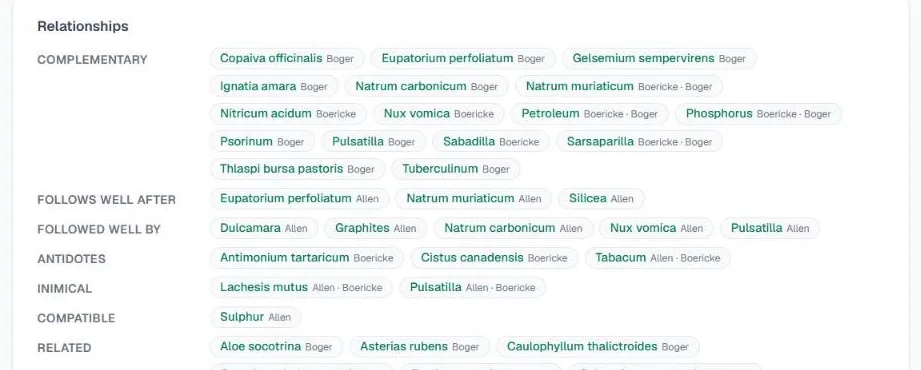
Sepia's relationships, 14 September 2026.
For Practitioner Pro
Three reading tools are part of Practitioner Pro:
- By section lays the books side by side by topic, so you can read Mind in Boger, Boericke and Kent one after another.
- Compare opens two or more remedies side by side, section by section.
- Highlights and notes let you mark words in a passage and keep your own notes beside them. They can be exported from Bookmarks as W3C Web Annotations.
Print is open to everyone and gives a clean copy of the page with every book.
Joined up with your practice
Your rubrics in its books
In the repertory, open a remedy from your analysis and choose its Materia Medica tab. Your rubrics in its books shows, rubric by rubric, where that remedy's books speak of the symptom, with the words highlighted, so you can read the passage before you trust the ranking.
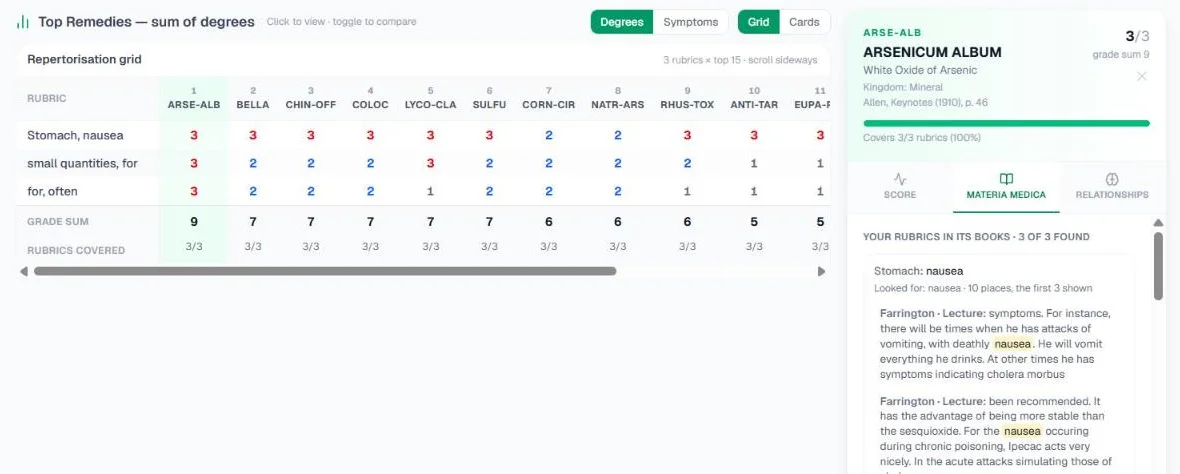
Arsenicum album in a three-rubric analysis, 14 September 2026.
In the books, after a case
After a case with an answer key, Why this score now ends with In the books: short passages from Allen and Boericke for the remedy you prescribed and for each remedy in the key, with Read it all to open the full page.
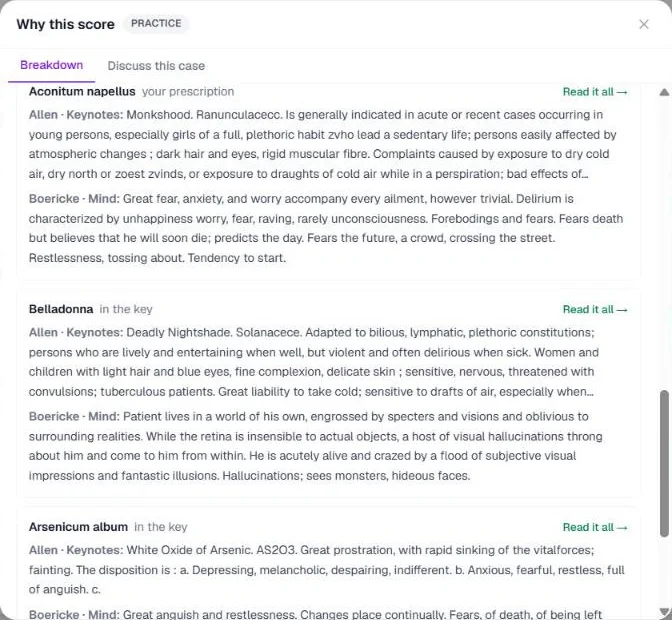
The debrief of a practice case on our own account, 14 September 2026. The Allen passage for Aconitum still shows scanning errors, such as "zvho" for "who"; see Corrected texts below.
Corrected texts
- Kent's Lectures were re-imported whole: 180 lectures, each under the right remedy.
- Farrington's Clinical Materia Medica is back, one passage per lecture, 140 in all, with page numbers.
- Allen's Keynotes is now the third edition of 1910, from a public-domain scan, replacing a later rearranged edition.
- 138 duplicate remedy records were merged, so each remedy has one page. Old links still lead to it.
- Boericke's Female and Modalities paragraphs now sit in sections of their own.
- Key facts for 184 remedies are cited to the page of Allen's Keynotes they come from.
- 296 scanning errors were corrected, each checked by a person before it changed the text.
- Three descriptions copied from the withdrawn edition of Allen were removed.
Scanning errors remain. For example, 28 of Allen's keynotes read "zv" where the book has "w". Their corrections go through the same review before they change anything.
The free public pages
You do not need an account to read the public-domain books. The free Materia Medica pages now cover 695 remedies, and each page shows every public-domain book in full rather than a selection of excerpts, with contents, a Where each author writes table and a citation for each passage. Tyler's Homoeopathic Drug Pictures stays inside the library for members, as do search, saving and the link to the repertory.
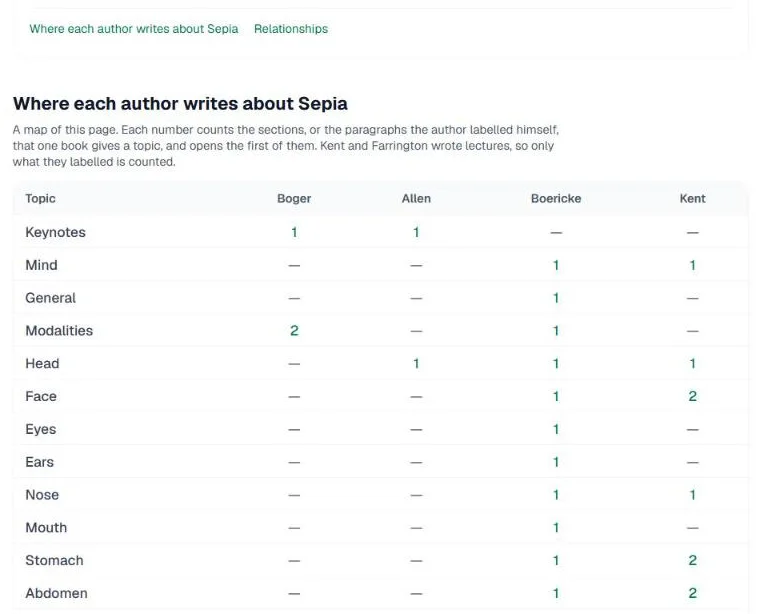
The public Sepia page, 14 September 2026: which topics Boger, Allen, Boericke and Kent each write about.
Lighter and easier to read
- The library page is about a fifth of its old size (72 KB instead of 390 KB), because the remedy list now loads after the page.
- Text that was too faint was darkened, so the library meets the WCAG 2.2 AA contrast standard.
What is still in progress
- Scanning corrections. More are waiting for review, including the 28 Allen keynotes above.
- The Android app still reads its own copy of the texts. It moves to this library once testing on phones is done.
Where to go next
- The Materia Medica library guide
- Repertorisation, step by step
- What's new in the case simulator and the repertory
Or go straight to the library.
Dr. Harish Kumar
Homeopath and founder of HomeopathyWorld. Writes on materia medica, case-taking, repertory and the Organon for students and practitioners.
Put this into practice
Repertorise these symptoms against the real Kent & Bönninghausen, read the full Materia Medica, and practise the case on an AI patient — free account, no card required.
Create your free accountMore in What’s new
Discussion
Sign in to join the discussion.
No comments yet — start the conversation.